
NGO Registrations
About NGO (Non Government Organization)
Start Your Journey of Social Impact with a Legally Registered NGO
An NGO (Non-Governmental Organization) is a non-profit entity formed to serve social, charitable, educational, religious, environmental, or community welfare objectives. In India, NGOs can be registered in three primary legal forms: Charitable Trust, Society, or Section 8 Company under the respective governing laws.
At Begrowz, we help individuals, groups, and organizations transform their vision for social change into a legally recognized NGO with complete registration support and compliance guidance.
NGO registration is an essential step for any organization that wishes to operate transparently, gain legal recognition, and access funding opportunities such as government grants, CSR contributions, and donations from individuals and institutions.

GET A QUOTE

Types of NGO
Select the legal structure that best suits your organization’s goals, scale, and governance preferences.
01
Section 8 Company Registration
A non-profit company incorporated under the Companies Act, 2013. The most credible and structured form for large NGOs, CSR projects, and funding-driven organizations.
02
Charitable Trust Registration
A trust-based legal arrangement under the Indian Trusts Act, 1882. Perfect for family trusts, temples, schools, and charitable institutions with trustee-controlled management.
03
Society Registration
A membership-based association registered under the Societies Registration Act, 1860. Ideal for associations, clubs, and educational & welfare groups seeking democratic governance.
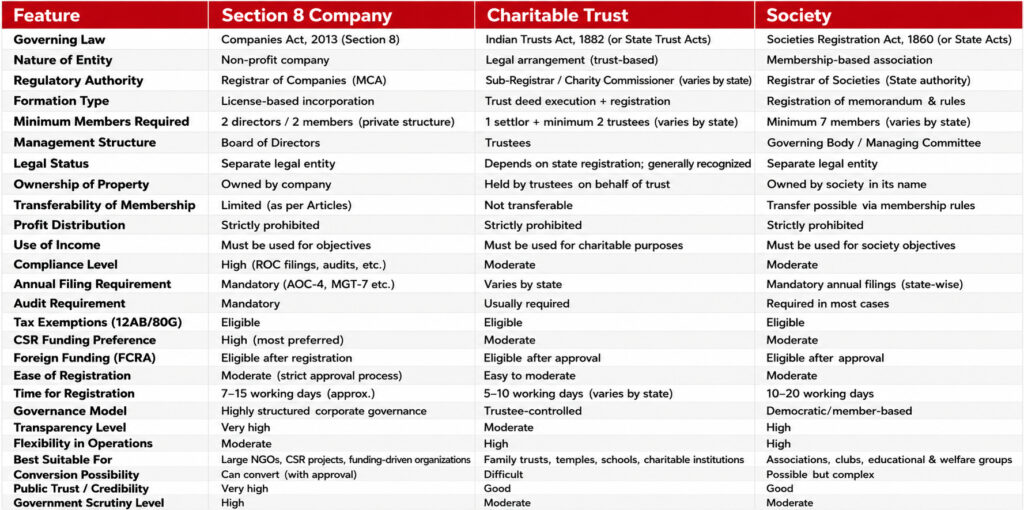
NGO Registration Comparison
Section 8 Company Registration in India
Start Your Journey of Social Impact with a Legally Registered NGO
At Begrowz, we help individuals, groups, and organizations transform their vision for social change into a legally recognized NGO with complete registration support and compliance guidance.
NGO registration is an essential step for any organization that wishes to operate transparently, gain legal recognition, and access funding opportunities such as government grants, CSR contributions, and donations from individuals and institutions.
Our Services Include
- Name Approval for Section 8 Company
- DSC & DIN Application
- Incorporation Filing with MCA
- MOA & AOA Drafting
- Section 8 Company Compliance Setup
- PAN & TAN Application
- Banking Assistance
What is a Section 8 Company?
A Section 8 Company is a not-for-profit company incorporated under the Companies Act, 2013. It is formed to promote charitable or socially beneficial objectives such as:
- Education, Healthcare, Environmental Protection, Social Welfare, Rural Development, Arts & Culture, Scientific Research, Sports Promotion, Skill Development, Women’s Empowerment, Animal Welfare, and Religious & Charitable Activities.
- Unlike profit-making companies, a Section 8 Company applies its income and profits solely toward achieving its stated objectives. Profits cannot be distributed as dividends to members.
Benefits of Section 8 Company Registration
- Separate Legal Entity: A Section 8 Company has its own legal identity, enabling it to own property, enter into contracts, and conduct activities in its own name.
- Limited Liability: Members’ liability is generally limited to the amount they agree to contribute, subject to applicable law.
- High Credibility: Section 8 Companies are widely recognized by government bodies, donors, CSR contributors, and funding agencies for their structured governance.
- Better Funding Opportunities: Many grant-making organizations and corporate CSR initiatives prefer working with formally registered Section 8 Companies.
- Perpetual Succession: The organization continues to exist despite changes in its members or directors.
- Tax Benefits: Eligible Section 8 Companies may apply for registrations such as 12AB and 80G, subject to approval by the relevant authorities.
- National Presence: A Section 8 Company can carry out activities across India in accordance with its governing documents and applicable laws.
Eligibility Criteria
To register a Section 8 Company in India, you generally need:
- Minimum 2 Directors (Private Structure).
- Minimum 2 Members.
- At least 1 Resident Director.
- Registered Office Address in India.
- Digital Signature Certificates (DSC).
- Director Identification Numbers (DIN), where applicable.
- Charitable or Non-Profit Objectives.
- No intention to distribute profits to members.
Get Your Section 8 Company Registered In Following Steps
01
Initial Consultation
Our experts understand your organization's objectives & and suggest
02
DSC & DIN Application
Obtain Digital Signature Certificates and Director Identification Numbers
03
Name Reservation
Apply for company name approval through MCA
04
Drafting of MOA & AOA
Prepare incorporation documents aligned with Company's objectives
05
Incorporation Filing
Submit application with MCA
06
Certificate of Incorporation & Section license
Receive CIN and legal registration certificate
07
PAN & TAN and Banking Setup
PAN/TAN allotment and open current a/c for Company after incorporation

Who Should Register a Section 8 Company?
- A Section 8 Company is suitable for:
- Charitable Organizations
- NGOs & Educational Institutions
- Healthcare Organizations
- Social Welfare Groups
- Environmental Organizations
- Research Institutions
- Skill Development Centers
- Women Empowerment Initiatives
- Child Welfare Organizations
- Cultural Promotion Organizations
- Religious & Charitable Organizations
- CSR Implementation Agencies
- Public Welfare Foundations
Charitable Trust Registration in India
Register a Charitable Trust with Expert Assistance
A Charitable Trust is one of the most widely adopted legal structures for establishing an NGO in India. It is ideal for individuals, families, and organizations committed to charitable, religious, educational, medical, or social welfare activities.
At Begrowz, we offer end-to-end assistance for Charitable Trust Registration, making the entire process simple, efficient, and legally compliant. Our services include drafting the Trust Deed, preparing and reviewing the required documents, registering the trust with the appropriate authority, and providing post-registration compliance support
Whether you are establishing a charitable organization, educational trust, healthcare institution, or social welfare initiative, our experienced professionals guide you through every step of the registration process.
Since the registration process and legal requirements vary from state to state, we ensure that your trust is registered under the applicable laws. While some states have dedicated Trust Acts, others follow different registration frameworks. Our team helps you navigate these state-specific requirements with ease.
Our Services Include
- Trust Deed
- Trust Registration Certificate
- PAN Application
- Assistance Professional Registration Support
- Compliance Guidance
Benefits of Charitable Trust Registration
- Legal Recognition: Registration provides formal legal recognition, enhancing the trust’s credibility.
- Build Donor Confidence: A registered trust inspires confidence among donors, grant-making organizations, CSR contributors, and volunteers.
- Separate Legal Identity: A registered trust can own property, enter into contracts, and carry out charitable activities in accordance with applicable law.
- Eligibility for Tax Benefits: Eligible trusts can apply for registrations such as 12AB and 80G, subject to approval by the Income Tax Department.
- Long-Term Stability: A trust provides continuity for charitable activities, allowing the organization to function over the long term according to its Trust Deed.
- Ability to Receive Grants and Donations: Registered trusts are generally better positioned to receive donations, CSR support, grants, and philanthropic funding.
- Protection of Charitable Assets: Assets dedicated to the trust are managed according to the Trust Deed and applicable legal provisions.
Eligibility Criteria
- Founder (Settlor).
- Minimum Two Trustees (requirements may vary based on state).
- Charitable or Religious Objectives.
- Trust Name.
- Registered Office Address.
- Trust Property or Initial Corpus (where required).
- Trust Deed.
- Identity and Address Proof of Trustees.
What is a Charitable Trust?
A Charitable Trust is a non-profit legal arrangement created to promote public welfare through charitable or religious activities. It is established when a founder (settlor) transfers assets or property to trustees, who manage them for the benefit of the public according to the Trust Deed
Get Your Charitable Trust Registered In Following Steps
01
Initial Consultation
Our experts understand your objectives and advise on the most suitable trust structure.
02
Drafting the Trust Deed
We prepare a professionally drafted Trust Deed covering (Trust objectives, Powers, Trustee responsibilities, Management rules, Beneficiary etc.)
03
Execution of Trust Deed
The Trust Deed is executed on the appropriate stamp paper as per state requirements
04
Registration with the Appropriate Authority
The Trust Deed is submitted to the relevant registration authority, such as the Sub-Registrar or other authority prescribed under applicable state law
05
Registration Certificate
Upon successful registration, the trust receives legal recognition under the applicable law.

Society Registration in India
Register Your Society Online with Expert Assistance
A Society is one of the most common non-profit legal structures in India used for promoting charitable, educational, literary, scientific, cultural, and social welfare activities. It is governed by the Societies Registration Act, 1860 or respective State Societies Registration Acts.
At Begrowz, we provide complete assistance for Society Registration, including documentation, drafting of Memorandum of Association (MOA), Rules & Regulations, filing with the Registrar, and post-registration compliance support.
Our Services Include
- Society Registration
- Drafting of Memorandum of Association (MOA)
- Rules & Regulations (Bylaws)
- Compliance Guidance
What is a Society?
A Society is a voluntary association of individuals who come together for a common non-profit purpose such as education, charity, science, art, culture, sports, or social welfare. It is registered under the applicable law and operates through a governing body or managing committee elected by its members.
Societies are commonly formed for: Education and Schools, NGOs and Welfare Organizations, Cultural Associations, Sports Clubs, Religious and Community Groups, Research and Scientific Institutions, Healthcare and Medical Welfare, Women Empowerment Groups, Environmental Protection Groups, and Skill Development Program etc.
Benefits of Charitable Trust Registration
- Legal Recognition: A registered Society gains legal identity, allowing it to operate formally and enter into contracts.
- Credibility for Funding: Registered Societies are eligible to receive donations, grants, and CSR funding (subject to compliance requirements).
- Democratic Structure: Societies are governed by members through elections and meetings, ensuring transparency and accountability.
- Separate Legal Entity: A registered Society can own property, sue or be sued in its own name.
- Tax Benefits: Eligible Societies can apply for 12AB and 80G registrations to obtain tax exemptions.
- Flexibility in Operations: Societies offer flexibility in management compared to more rigid corporate structures.
- Perpetual Succession: The organization continues to exist despite changes in its members.
Eligibility Criteria
- Minimum 7 Members (requirements may vary by state).
- Members from different states (required in some cases for National-Level Societies).
- A unique Society Name.
- Registered Office Address in India.
- Memorandum of Association (MOA).
- Rules and Regulations (Bylaws).
- The objective of the Society must be non-profit in nature.
- Requirements may vary depending on the state where the Society is registered.
Get your Society registered in following steps
01
Initial Consultation
Our experts understand your objectives and suggest the appropriate Society structure..
02
Document Collection
We collect and verify all required member and office documents
03
Drafting of MOA & Rules
We prepare legally compliant documents including , Memorandum of Association (MOA) Rules and Regulations (Bylaws) Governing Body Structure Objectives and Activities
04
Filing with Registrar
The application is submitted to the Registrar of Societies under the applicable State Act.
05
Registration Certificate
Upon successful approval, the Registrar issues the Society Registration Certificate.

Who Should Register as a Society ?
- NGOs and Non-Profit Organizations
- Educational Institutions, Schools, Colleges, and Training Institutes
- Cultural Associations, Sports Clubs, and Academies
- Research Organizations and Welfare Associations
- Resident Welfare Associations (RWAs)
- Religious and Community Groups
- Environmental Organizations
- Healthcare NGOs
- Women and Child Welfare Organizations
NGO Registrations & Certifications in India
After registering an NGO as a Trust, Society, or Section 8 Company, several important certifications and registrations help improve funding opportunities, tax benefits, and legal recognition
- I. 12A Registration (Income Tax Exemption): 12A registration allows NGOs to get exemption from income tax on their surplus income. It has following key benefits;
- NGO income is not taxed (subject to conditions)
- Helps in long-term financial sustainability
- Mandatory for most NGOs to reduce tax burden
- II. 80G Registration (Donor Tax Benefits): 80G registration allows donors to claim tax deductions on donations made to the NGO. It has following key benefits;
- Encourages more donations
- Donors get tax exemption benefits
- Improves NGO credibility and fundraising ability
- Without 80G, donors may hesitate to contribute larger amounts.
- III. CSR Registration (CSR-1 Form): CSR (Corporate Social Responsibility) funding allows companies to donate a portion of their profits to NGOs. It has following key benefits;
- Access to corporate funding
- Collaboration with large companies
- Long-term project funding opportunities
- IV. NGO DARPAN Registration (NITI Aayog Portal): NGO DARPAN is a government portal maintained by NITI Aayog for NGO registration and transparency.
- Unique NGO Darpan ID
- Required for government grants
- Improves credibility with ministries and agencies
- Acts as an official NGO database record
- V. E-Anudaan: It is an online government portal that enables eligible NGOs to apply for government grants, submit required documents, and track their applications through a transparent and digital process. It has following benefit;
- Easy access to government funding opportunities
- Faster and more transparent approval process
- Reduced dependency on offline procedures
- Better monitoring of project progress
- Increased credibility of NGOs
- V. FCRA Registration (Foreign Funding Approval): FCRA (Foreign Contribution Regulation Act) registration is required for NGOs that want to receive foreign donations.
- Legal permission to receive foreign funds
- Enables international donations and grants
- Required for global NGO partnerships
Documents Required
- For Director / Member / Settlor / Trustee:
- PAN Card
- Aadhaar Card
- Passport (for foreign nationals)
- Passport-size Photograph
- Email Address
- Mobile Number
- Identity Proof
- Address Proof
Registered Office Documents
- Registered Office Documents:
- Latest Utility Bill
- Rent Agreement (if rented)
- No Objection Certificate (NOC) from the Property Owner
- Ownership Proof (if owned)
- Additional Documents: Additional certifications and supporting documents of the Section 8 Company, Trust, or Society are required for 12A, 80G, CSR, FCRA, Anudaan, and NITI Aayog registration.
Why Choose Us?
- Expert Assistance: Experienced professionals handling company registrations.
- Transparent Pricing: No hidden charges.
- Fast Processing: Efficient filing and regular updates.
- End-to-End Support: From incorporation to compliance management.
- Dedicated Team: Single point of contact throughout the process.
Frequently Asked Questions (FAQs) – Section 8 Company
No, there is no minimum paid-up capital requirement for Section 8 Companies.
It is a special license issued by the Ministry of Corporate Affairs under Section 8 of the Companies Act, 2013.
Frequently Asked Questions (FAQs) – Charitable trust
You can register through the trust’s website or contact directly.
Depends on activities and income; some services may attract GST.
Frequently Asked Questions (FAQs) – Society
There is no strict universal rule, but members must be legally competent adults (usually 18+ years).
Yes, in many cases foreign nationals can become members, subject to compliance requirements.